Revista Nordelta. The prodigy continues to amaze. In June, he’ll play again in Nordelta, where he’s shone on a couple of occasions…


Horacio Lavandera is already 40 years old and has a career spanning more than 25 years, always performing wonders on his piano. In June, he’ll return to Nordelta, where he shone on a couple of occasions long ago. In this interview, he reviews his musical career and announces the bold repertoire he’ll present.
Text: Juan Martín Roldán
The name Horacio Lavandera swept through Argentine and international classical music more than two decades ago. That child prodigy dazzled everyone with his magical interpretations of symphonies and piano concertos, leaving his mark on Nordelta from its very beginnings, when the city was just emerging. Today, Horacio is 40 years old; he’s no longer a child or a teenager, but he remains a prodigy of the musical arts, one of Latin America’s most internationally renowned pianists.
He’ll be playing in Nordelta again next June, and as a preview of that performance, he agreed to a chat with this magazine. He still has that boyish, awe-filled face and the warm smile that always characterized him, but today he appears more poised, confident in his words, and perhaps freed from the self-imposed demands his work and his own personality demand. “Five years ago, I started therapy,” he confesses. This coincided with the death of his father and mentor, José María, in July 2020.
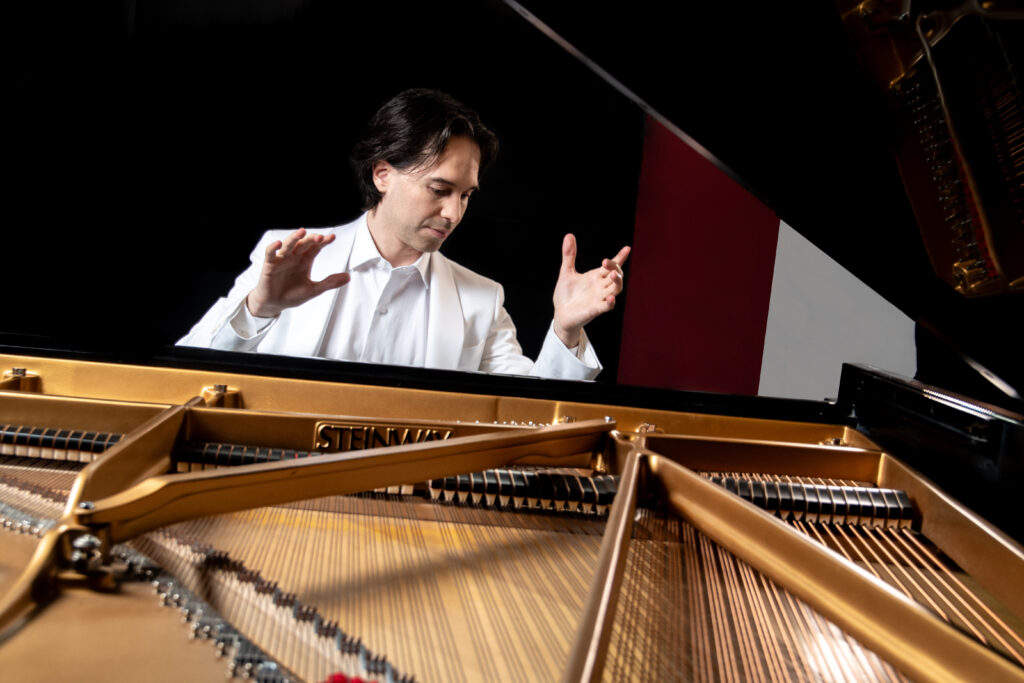
–How are you, Horacio?
–Fine, very fine. Last year I toured all of Argentina, visiting many of its major cities, all with the same program. I was also in the United States. Last May I played at Carnegie Hall in New York. I also inaugurated a concert hall at the University of Miami, and I did concerts in Minnesota… So it was a very beautiful tour with a repertoire very focused on the United States, with a strong emphasis on Gershwin and classical music. Also, I played a very important Argentine composer from a small town in Salta, Dino Saluzzi. I’m amazed by many of his works.
–You’ve been in your career for about 25 years, right?
–I started winning competitions, you could say professionally, when I was 13.
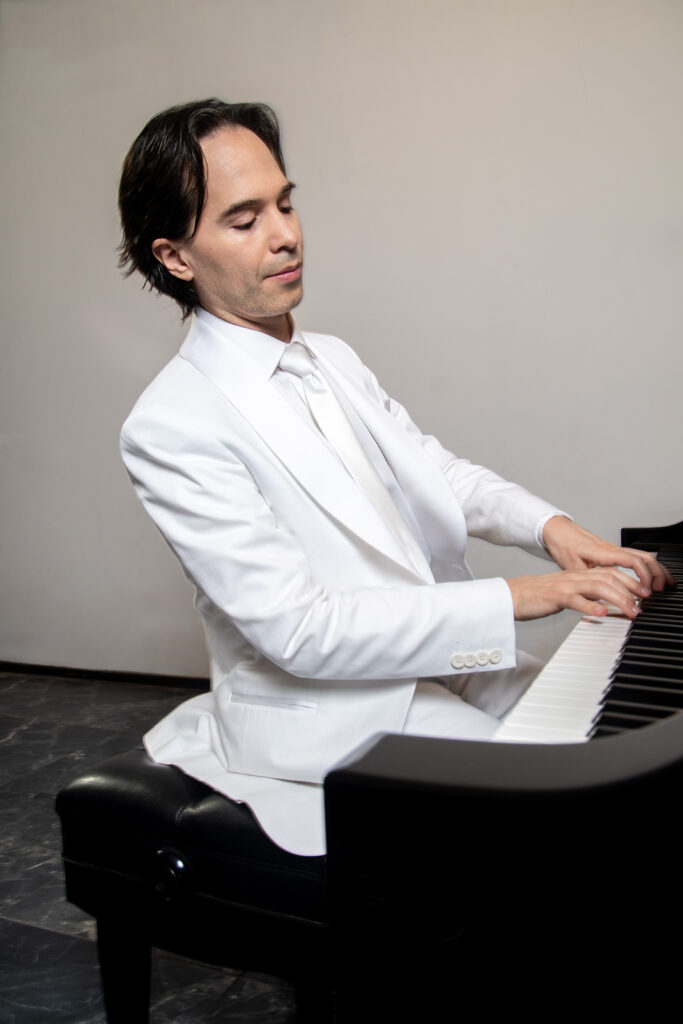
–So it’s been 27 years. What milestones can you recognize in this career?
–There are many decisions I’ve made throughout my life that aren’t summarized in my professional life, but in my entire life. I can’t separate it from music, of course. So, if you want a practical answer, let’s look at my resume. At 16, I won the Umberto Micheli Competition in Milan, I worked with Maurizio Pollini, a great Italian pianist, then I played in major European venues, and toured with the Orchestra of the Americas at just 18. Before that, at 16, I made my debut at the Colón and at La Scala in Milan. Those and other subsequent ones were major milestones. But if we go deeper, I think it all started when I was in my mother’s womb, when she was accompanying my sister’s first ballet steps, listening to classical music, listening to Bach, Tchaikovsky… And well, I was born in a very culturally conducive environment and I made the decision to be a musician at a very young age. The support of my family was key for me, something truly beautiful.
–Did you ever have to decide to dedicate yourself fully to music?
–It was like something… natural. But it’s true that at 12 years old, I told my parents that I wanted to seriously dedicate myself to music, and there were some conflicts. I already wanted to start preparing seriously for competitions; I wanted to take the risk of dedicating myself to it. Initially, there was resistance from my mother, but my father supported me every step of the way. And so it was that I dropped out of school and began to study 12 hours a day. It was a process of complicated decisions, very complex on a psychological level, a family level, an economic level, on every kind of level.
–And within music, was the piano always your choice, or was there something else at some point?
–No, it was always music as a global thing. I wanted to become a highly educated person, one who could embrace many cultures. That always haunts me. And the piano is the best vehicle for organizing yourself culturally, because it’s the most complete instrument. It allows you to compose, conduct orchestras, make independent arrangements, and connect with music much faster and more effectively than any other instrument. Yes, the piano is the perfect king instrument.
–Do you feel more comfortable as a soloist or accompanied by an orchestra?
I feel comfortable in both positions. I’ve been doing both since I was 13, always with such passion when playing solo or with an orchestra. We soloists have a very personal, very particular approach, and we have to pass that on to the rest of the musicians, who may have to study or view the work in a completely different way.
–Your profession demands perfection. How do you manage self-demand?
–To the point where it allows me to live in peace. That’s clear, isn’t it? It may be impertinent, but there has to be a limit. So the only thing I can say is that I’ve been in therapy for the past five years. In the last 20, 15 years, more and more psychological and group therapy resources have emerged to address the various difficulties an artist may encounter over the years. Perfection can be a very diabolical word, but I understand that as artists we have to seek it. In my own case, I’m fascinated by everything that has to do with all the details, for example, the different speeds of keystrokes, the colors, so to speak, that can be achieved with my instrument. And I try to bring all of this to the maximum expression, and for that I need to work hard, perfecting myself along the way. There are many movements involved; the whole body, the breathing, my whole being, the spiritual part, and everything that will resonate in that piano.
–Let’s move on to the repertoire. Do you choose it for each tour, for each performance?
–Yes. And now I have a very interesting, very beautiful repertoire, which I’m presenting for the Nordelta concert on June 28th. I haven’t played there since 2008.
–What will the people of Nordelta who haven’t seen you since then expect to find? It’s been 17 years.
–It’s hard for me to say. There are very similar things. I’m still searching for, let’s say, the same details. But we could spend five hours talking about what happened to me from that moment on. Essentially, I’m the same person, and I’m going to present a different repertoire, closely linked to a project I’m putting together that’s being defined to go to Liverpool, the city of The Beatles. The concert is dedicated to Beethoven in the first part, with two very popular English songs, on which Beethoven made variations, and then come the Diabelli Variations. It’s a central work in the existence of the piano instrument, a marvelous, gigantic work. It lasts almost an hour, and Beethoven doesn’t strictly call them variations, but rather transformations. There are some transformations that last a few seconds. And then there are transformations that last five or six minutes, based on a very popular Austrian song, a waltz.
–How’s your concert repertoire going?
I chose Gustav Mahler as one of The Beatles’ most important references when it came to writing songs. I found him very interesting.
That’s explicit. Did Lennon and McCartney talk about Mahler?
It seems so. It makes sense, because Gustav Mahler became one of the most popular composers after World War II, when they were children, so it wouldn’t surprise me at all if they were listening to the radio in Liverpool, these Mahler melodies came on, and they tried to play them. Paul had a piano at home, his father played. And I found it very interesting to connect Mahler with The Beatles, and those are completely my own versions, the same as Gustavo Cerati’s. That’s how I bring all this into my emotional world, the world of classical music. I mean, I bring something very popular to variations, fugues, canon, and all the procedures of classical music, but also some avant-garde music and improvisations. You can already hear it all on my YouTube channel, but it will be the first time I’m doing it live.
You’ve appeared at rock concerts, like Ciro y Los Persas in 2019, but it will be the first time you’ve performed it in your own concert, right?
–If we call Gustavo Cerati’s work rock, it’s the first time I’m going to play that. Although translated into classical music. And yes, of course, I can do this because I have training as a composer; I compose constantly.
–What do you look for in your compositions? What are you oriented towards?
I have many influences. Some nationalist themes, like a series of dances, a tango, a chacarera, a zamba for four hands that premiered all of them, a duet, a Japanese pianist, and a German pianist. They premiered all of these pieces in Germany. I have recorded about 40 of my opuses.
–When did you start composing?
It’s something I’ve always had composition teachers for, since I was very young. On YouTube, there are compositions from when I was younger. I also have some tributes to Gershwin, which was a composition from when I was eight years old; I still have to record that. And then there’s a whole section that has to do with science. I’m very interested in it; it always seemed to me there was a path there for music, for infinite development.
– That’s curious, isn’t it? Because one initially thinks of mathematics or physics as exact, hard sciences, in contrast to the arts and their creative side. How do you unite those two paths?
Well, there’s no contrast, really. They’re linked. If not, all of Leonardo da Vinci’s work, for example, wouldn’t make any sense. The greatest creators have drawn on mathematics, physics, and astrophysics to create their best compositions, their best works. So it’s not surprising at all; it’s the most natural thing for knowledge.
– Do you have any pending dreams?
–Yes, of course, thousands of dreams. Can I tell you one? I’d like to form my own orchestra again, which I had until my father died. He organized it and was the executive director. I’d like to organize it, perform piano concerts, by Mendelssohn, by Schumann, by all of Gershwin. I like it as a challenge for the future.
–Let’s close the interview with your top three favorite composers.
Beethoven is the first, without a doubt. Then Mozart and Johann Sebastian Bach. Not in that order, because I don’t have a number three. I do have to name these three. Mozart and Beethoven because of the sheer number of works. Just think, I’m going to die and I won’t be able to play all of these composers’ piano works. We’re talking an overwhelming number of works; it’s impressive. And then the quality. Each work is unique.


