Noticias Mercedinas. Horacio Lavandera, a concert that resonated beyond the piano


Horacio Lavandera, a concert that resonated beyond the piano
March 24, 2026
By Susana Spano
There are concerts, and then there are musicians. Audiences have always been moved by the diverse interpretations that performers offer of works from the universal repertoire, but only rarely does this tradition materialize with an interpretive power capable of renewing the listening experience.
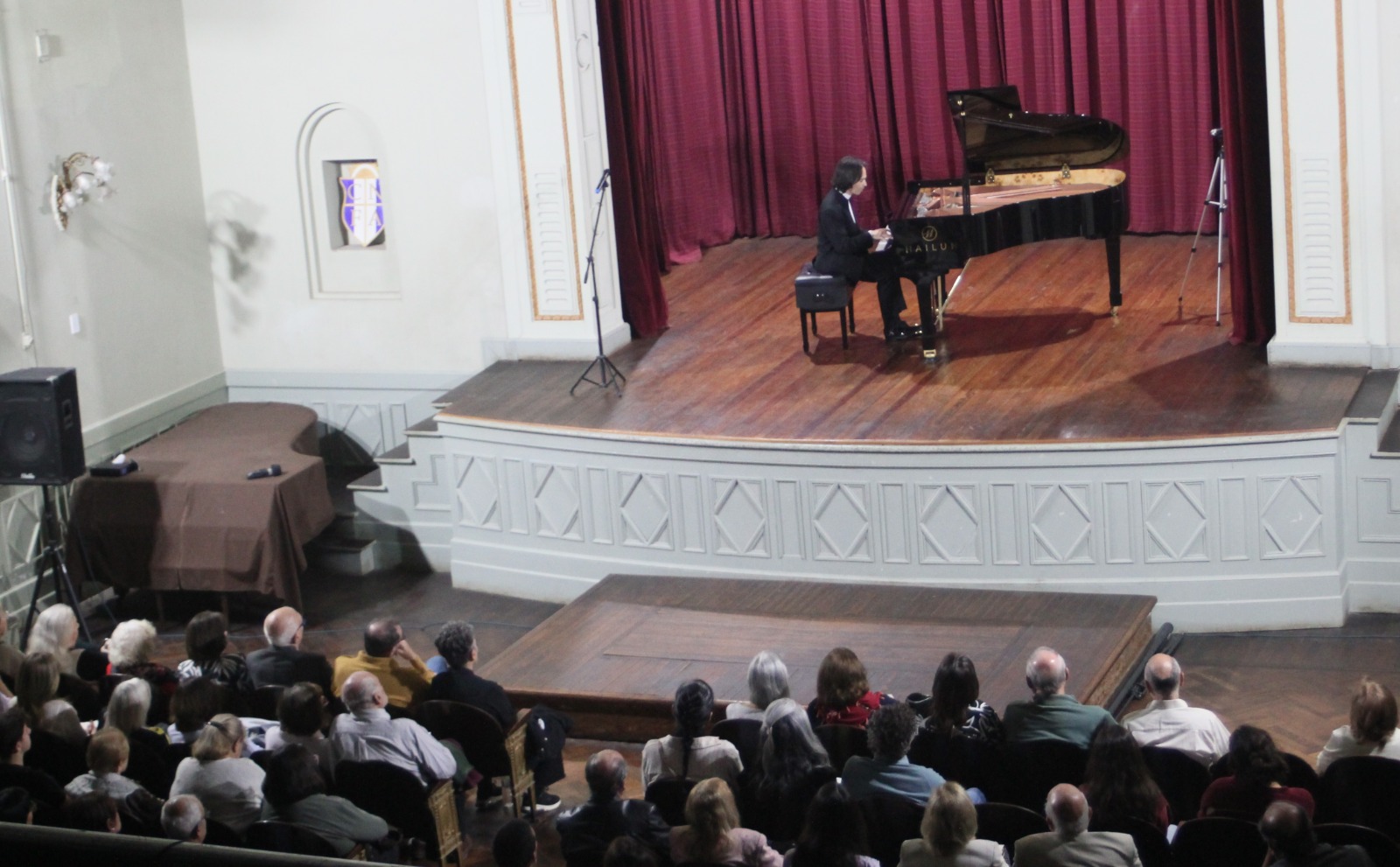
In the concert on Saturday, March 21, of the Pro Arte Mercedes Cycle, Horacio Lavandera offered a performance that authoritatively inscribed itself in that rare territory where the work and the performer seem to converge in a single expressive impulse.
The program, conceived as a true tour de force, showcased a performer who flawlessly maintained absolute mastery of the instrument and displayed a remarkably refined musicality, expressed in contrasts ranging from “presto fortissimo” to the most subtle “pianissimo,” transforming the listening experience into a profoundly immersive one.
The concert, entitled “Cinema at the Piano,” combined classical works and film music, from Johann Sebastian Bach to John Williams, all linked in some way to the German genius.
The first part focused on Bach (1685–1750), with the Concerto based on Marcello, BWV 973; the Chromatic Fantasia, BWV 903; and the Goldberg Variations, BWV 988.
The Marcello Concerto, whose music—particularly the celebrated Adagio—has resonated in soundtracks such as Anonymous Venetian (1970), took shape in Lavandera’s hands with a sound faithful to the harpsichord’s evocative quality. The precision of her touch highlighted the contrapuntal structure, infusing each phrase with a clear and expressive eloquence.
The Chromatic Fantasy and Fugue, with its intense emotional charge and improvisational character, was approached with restraint and subtlety, allowing the dramatic tension and the richness of its polyphonic structure to emerge. In the freer passages, the fluidity of the musical discourse revealed a profound understanding of Baroque language.
Finally, the Goldberg Variations, a paradigm of formal complexity and technical rigor, were performed with exemplary structural clarity, making perceptible both the triad organization and the systematic use of the canon. Lavandera shaped the contrasts and progression with rigor and musicality, resulting in a performance of remarkable balance between virtuosity, transparency, and internal coherence.
In the second part of the program, the pianist performed Astor Piazzolla’s Oblivion and Punta del Este Suite—the former included in the soundtrack for Marco Bellocchio’s Henry IV—along with Golijov’s Youth Without Youth and Levante—composed for Francis Ford Coppola’s film of the same name—with clear phrasing and a pulse that gave direction and intention to each work.
A highlight of the recital was dedicated to Chopin, with performances of the Nocturne in C-sharp minor, Op. posth.; the Andante Spianato and Grand Polonaise, Op. 22; and Ballade No. 1 in G minor, Op. 23—all featured in the soundtrack for the film The Pianist. These works revealed the performer’s versatility and refinement, as he delicately shaped each phrase, offering a particularly exquisite version of Ballade No. 1.
To close the program, Horacio Lavandera delivered a masterful rendition of John Williams’s Star Wars Suite (1932), with his own arrangement that condensed the richness of the original, massive orchestra into a piano version. Adapting the themes “Title Theme,” “Across the Stars,” and “Cantina Band,” the performer displayed surprising nuances, precise changes in intensity, and a sonic clarity that made the work feel as if the entire orchestra were present.
The audience rose to their feet, giving the artist a standing ovation. In addition to the generous program, he surprised them with a sublime version of Debussy’s “Clair de Lune” and an electrifying performance of Lalo Schifrin’s “Mission: Impossible,” captivating in its virtuosity and intensity.
There are concerts and there are musicians, but the one on March 21, 2026 will forever remain in the annals of Pro Arte Mercedes, with the hall of the National College vibrating with every note and reflecting the emotion of an audience devoted to this young and extraordinary artist, who offered an intense, lively and absolutely memorable performance.