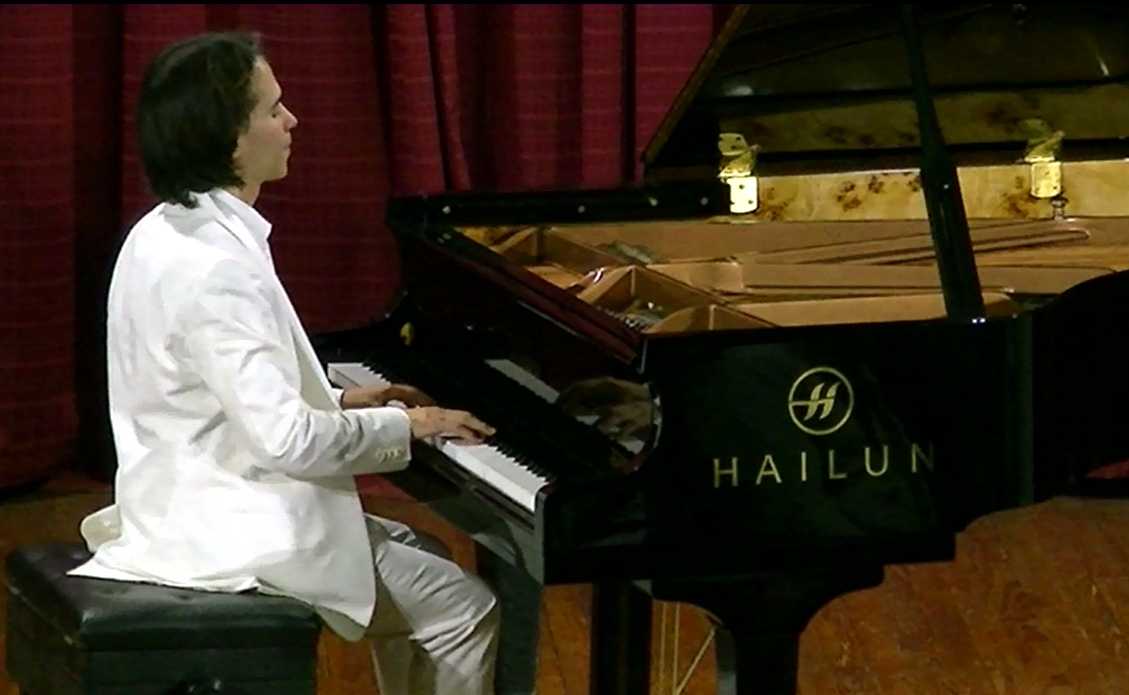
Noticias Mercedinas. Horacio Lavandera’s brilliant performance at the Pro Arte Mercedes Series. By Susana Spano. June 8, 2025


On May 31, the exceptional Argentine pianist Horacio Lavandera performed in the Pro Arte Mercedes series in a concert titled “Sounds of the Eternal.”
With a program that was a true tour de force due to the complexity of the selected works, the performer not only showcased his virtuosity but also his excellence as a composer
Through a subtle timeline, Lavandera united past and present in an ethereal and evocative musical parable, which transported the audience to unique and unrepeatable experiences.
In the first part, dedicated to Beethoven, he performed two works rarely heard in concert due to their complexity: the “God Save the King” Variations, Op. 78, a tribute Beethoven dedicated to the kings of England, transforming popular melodies into universal hymns, and the Diabelli Variations, Op. 120.
Since their publication in July 1823, Diabelli’s 33 Variations on a Waltz have been universally considered, along with Bach’s Goldberg Variations, to be the pinnacle of variation form and the greatest of all piano works.
Horacio Lavandera offered a version in which he demonstrated excellent technical mastery and precise phrasing. The internal balance of each variation was balanced with controlled intensity, contrasting the subtlety of the rubatos with the maximum power demanded by this monumental work, in a unique and sublime performance.
In the second half of the concert, the artist tackled a contemporary program, beginning with Mahler’s post-Romanticism and culminating in the rock movements, represented by the Beatles and Cerati.
In November 1905, Mahler made four piano rolls for M. Welte & Söhne in Leipzig that give us an incredibly precise and detailed impression of how he interpreted the music (at least, how he interpreted it in the piano transcription).
Maestro Horacio Lavandera, in a unique revision work, analyzed these rolls, which he adapted from Mahler’s works, bar by bar.
From the cycle of Songs from the Wandering Comrade, which, according to the Beatles, they listened to in their youth, he offered a beautiful and exquisite version of “Ich ging mit Lust” (“I Came with Joy”).
He then performed adaptations of Symphonies I and IV, the Funeral March, and a moving version of the Adaggietto from Symphony V, which was one of the most beautiful moments of the recital.
Finally, he offered his own versions of Beatles songs, for which he called upon two musicians from the English Renaissance period: William Byrd (1540–1623) and John Dowland (1563–1626).
Byrd was the most famous composer of the Tudor era, and his notable output included minstrels, a vernacular polyphonic form consisting of a solo song for a high voice, accompanied by four Renaissance instruments (usually viols) sung by medieval minstrels.
Dowland was an English composer and lutenist who composed gallant songs with melancholic, harmonic music that was fashionable at the time, and whose influence has been noted, including on Sting.
Inspired by these two great Renaissance musicians, Horacio Lavandera masterfully introduced the polyphonic form into Harrison’s song “My Guitar Weeps ,” reproducing on the piano with marvelous technical skill the solo that Eric Clapton played in the original recording at Harrison’s request.
The versions of “Yesterday” and “Imagine” conveyed echoes of Dowland’s melancholic songs, in which Lavandera provided a pure sound with beautiful timbres that created an intimate and profound atmosphere.
The Beatles cycle concluded with “Eleanor Rigby” and “I Saw Her Standing There.”
Finally, he offered three versions of Gustavo Cerati: “De Música ligera,” “Té para tres,” and “En la ciudad de la furia,” which he related to the work of the great Argentine musician Alberto Ginastera.
The idea of finding connections with Ginastera’s music was another discovery by the musician, which was fully demonstrated when he related La ciudad de la furia to the final dance of the Ballet Estancia: Malambo, which he performed impeccably.
Horacio Lavandera demonstrated why he is today an undisputed authority in the piano world. Admiration, ecstasy, and emotion, with a standing-room-only audience, rewarded a performance that will surely live long in the memory.
Finally, with his talent and generosity, he gave us a majestic and unique version of the Argentine National Anthem.
An unforgettable concert, a remarkable artist, who allows us to embrace the words of one of the most influential composers of the 20th century, Karlheinz Stockhausen, who said about him: “Your talent is God-given.”