La Prensa, Lavandera, both in his homeland and at Carnegie Hall. The distinguished pianist will perform on November 16 at the Coliseum.


The distinguished Buenos Aires pianist will perform on November 16 at the Coliseum
About to turn forty, the internationally renowned musician will perform an eclectic repertoire in Buenos Aires (Mozart, Gershwin, Dino Saluzzi), the same one he recently offered on a tour of the United States.
By Carlos Ernesto Ure 09.14.2024
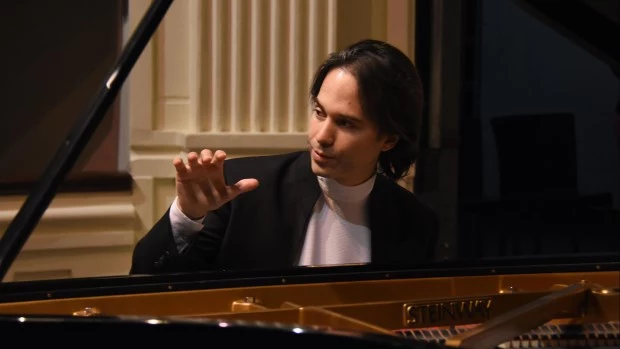
“It is very interesting to see how Argentine music can stand out,” says Lavandera. “An author who is becoming increasingly popular in Europe and North America is (Julian) Aguirre.”
“Last year I performed in Manchester, Munich, the Gewandhaus in Leipzig, among other musical centers,” says Horacio Lavandera from his place in the world, Villa Devoto, and adds: “In 2024, in the United States, I inaugurated a hall at the University of Miami, I gave two recitals in Minnesota and I finished the tour on May 10 at Carnegie Hall, where I offered a truly original program, which I am going to reproduce now as is in our city.” The performance will be on November 16 at the Teatro Coliseo and the repertoire will include works by Mozart, Mendelssohn, Gershwin and the Argentine composer Dino Saluzzi.
REPERTOIRE
A disciple of Antonio de Raco and Maurizio Pollini, close to turning forty, unstructured and always open to new paths, the distinguished Buenos Aires pianist has been developing a stellar career since his early youth that has taken him to major international stages (including, of course, the Colón) and to receive awards of notable relevance (the one awarded to him by the La Scala Philharmonic Orchestra in Milan was extraordinary).

-How did the idea of putting together an evening with works by such diverse authors and eras come about?
-The atmosphere of the large New York venue is rather serious, so I felt that I could not fail to include classical composers, along with more current ones. That is, to interweave creations by more familiar musicians with others who are not so familiar. This repertoire was designed for Carnegie Hall
-But what is the common thread that links them all?
-The performance can be divided into three micro-groups. On the one hand, there are Mozart (the graceful Twelve Variations K 265), Schubert (Musical Moments and Impromptus D.780 and 899) and Saluzzi (I will explain why later). On the other hand, let us take Beethoven (the ‘Appassionata’ is the most beautiful and perfect piano sonata ever written) and Mendelssohn (Serious Variations, in D minor, his masterpiece for piano, intended precisely to pay tribute to Beethoven). And finally, in homage to the United States, pieces of unusual execution by Gershwin, a great keyboard player, very dry, impetuous, fast. It is, as you can see, a long performance. It seems very eclectic but it has its coherence.
-How did you discover Gershwin’s Improvisations?
-They are electronic transcriptions of improvisations taken note by note from pianola rolls, from the first electronic recordings he made himself: ‘Swanee’, ‘Someone to Watch Over Me’, ‘Funny Face’, ‘S Wonderful’, ‘The Man I Love’, ‘I Got Rhythm’. Their execution is an enormous challenge, it requires a truly virtuoso technique, it is very difficult. At more than one point they seem to have been written almost for three hands.
-And do they sound good on today’s modern piano?
-Of course, it was a lot of work to adapt them. It was a huge effort. But the result is great.
DINO SALUZZI
Approaching ninety years of age, the great musician from Salta, perhaps more widely known as a composer abroad than in our country, has a vast production that ranges from folklore, tango, jazz, the fusion genre, and Piazzollian lines.
-How did you get along with Saluzzi, Horacio?
-We have been doing things together for two decades. We are both performers-composers. His music has a lot of the most conservative and most authentic tradition, it is rooted in the experiences of the Andean peoples and it can be said that he is a continuation of Julián Aguirre. Both make up an enormous flow of purist styles of folklore. And that flow surprises with ideas, journeys, memories. It is up to me to enjoy it. In this project of piano pieces, I want to situate myself in the world of the purest Argentine creators, who sought the deep essence of the people through the piano. No fusion that could distort the essences.
– Are these original works for piano? Remember that Saluzzi is a bandoneon player.
-The Three Pieces (‘La casa 13’, ‘Claveles’ and ‘Donde nací’) were indeed composed for the keyboard. And I will tell you more: they are clearly romantic, introspective works, susceptible to being related even to composers of the German Romantic period. I have therefore played them several times in that country. Saluzzi follows Julián Aguirre in this field, within a nationalist line with many spaces and meditation, which can be linked to Schubert and Mozart in that they also delved into popular airs and rhythms. It is a way of understanding musical art, introspective, like transferring the indigenous people to the piano. An album that I recorded with his compositions was considered one of the best of 2015 in the United States. The great dream, since we have the northern creator in full activity, is that he writes a concert for piano and orchestra. We are working on that.
OTHER PERSPECTIVES
Although it may seem redundant, always restless, fervent in what he does, Horacio Lavandera lives to the fullest the passion of music, which surrounds him relentlessly. “It is very interesting to see how Argentine music can stand out at this point,” he continues. “An author who is of increasing interest in Europe and North America is Aguirre, I return to him, a zealous collector of the most genuine essences of the national tradition, especially from the North (I played his works not long ago in Madrid). Apart from this, I have recently become acquainted with another great bandoneon player, Tránsito Cocomarola, a brilliant creator of very valuable pieces, whose chamamecera music is also being requested abroad. But none of this is show business. It seems that musical contexts require renewal, new voices and interactions. Music that is still not fully explored in those latitudes arouses great interest. There are many creative lines there that seem to be running out. And that is why attention is paid to new lines and developments, with their rhythmic, melodic and colouristic resources.”
In this case, congratulations! Your next foray into chamamé and coastal airs will undoubtedly bring you continued joy.


